
10 Best Industrial Meat Grinder Machines for Global Buyers?
Choosing an industrial meat grinder machine is a production decision, not merely a search for the largest motor. Global buyers must compare throughput, grind consistency, sanitation access, electrical standards, and after-sales support. A polished stainless-steel frame may look impressive, yet hidden corners can slow cleaning and increase contamination risks.
Industry data shows why this equipment deserves careful evaluation. The OECD-FAO Agricultural Outlook 2024–2033 forecasts continued growth in global meat consumption, especially in developing markets. Grand View Research also identifies meat-processing equipment as a growing industrial segment, supported by automation, food safety requirements, and expanding processed-food production. These reports indicate stronger demand, but they do not make every machine suitable for every factory.
Details matter.
Food-design expert Temple Grandin wrote, “The thing that has made the biggest difference in my life is that I learned to think in pictures.” That principle is useful here. Buyers should picture operators loading chilled meat, removing the auger, washing the cutting plate, and checking the emergency stop. A machine that looks efficient in a brochure may feel slow beside a wet production floor.
This guide reviews ten leading machines for global buyers. It considers capacity, motor performance, stainless-steel construction, hopper design, safety features, maintenance, and verified manufacturer support. Product rankings remain imperfect because suppliers publish different test conditions. Some specifications also require direct confirmation. That gap matters.
Reliable purchasing requires evidence. Ask for test videos, food-contact material details, voltage options, spare-parts availability, and documented hygiene procedures before choosing an industrial meat grinder machine.
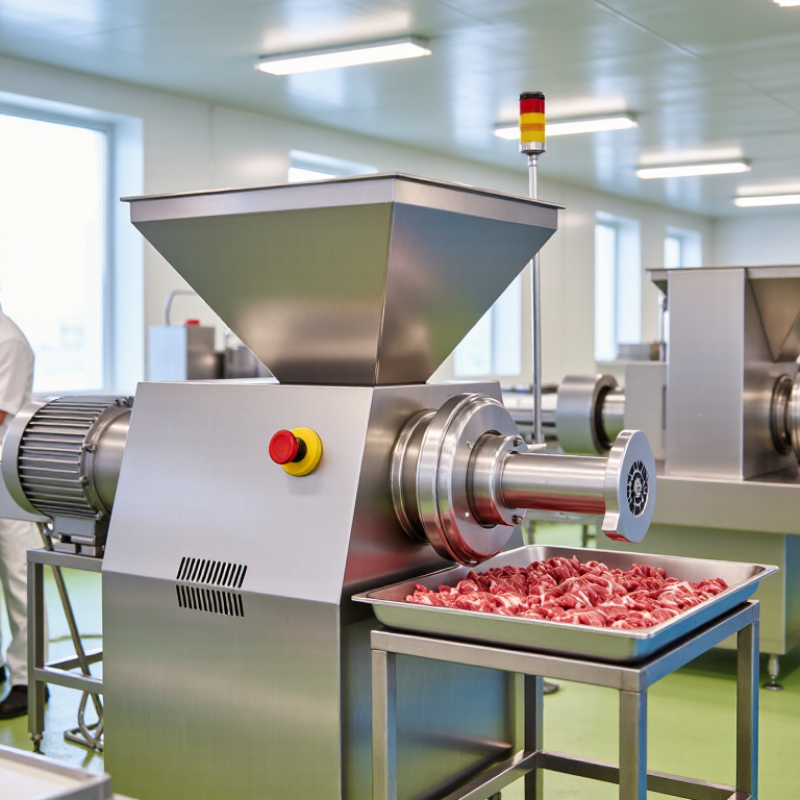
What Industrial Meat Grinders Are and How They Work
Industrial meat grinders are machines designed to process large quantities of meat efficiently. They usually include a feed tray, screw auger, cutting knife, perforated plate, motor, and protective housing. The auger moves meat forward at a controlled speed. The rotating knife then cuts it against the plate. Plate holes determine the final particle size.
Industrial models often use stronger motors and wider chambers than household grinders. This supports continuous production in butcher shops, food factories, and commercial kitchens. Stainless steel contact surfaces help resist corrosion and simplify cleaning. However, material quality still requires inspection. A polished surface does not guarantee hygienic performance. Operators should check welds, seals, corners, and drainage areas carefully.
Tips: Match plate size with the intended product. Use chilled meat for cleaner cutting and better texture. Never force oversized pieces into the feed opening. Confirm emergency stops, overload protection, noise levels, and voltage requirements before purchase. Cleaning must follow the machine’s instructions and applicable food-safety standards. In real production, maintenance is often underestimated. A dull knife can create smearing, heat, and uneven particles. That small issue may reduce both quality and output.
10 Best Industrial Meat Grinder Machines for Global Buyers? - What Industrial Meat Grinders Are and How They Work
Industrial meat grinders use a rotating screw conveyor to move meat toward a knife and perforated plate. The knife shears the meat as it passes through the plate holes, producing a consistent mince. The specifications below represent practical market ranges for common industrial configurations; actual output depends on meat temperature, product type, plate size, feed rate, and operating conditions.
| No. | Industrial Grinder Configuration | Typical Throughput | Typical Motor Power | Common Plate Diameter | Recommended Product Condition | Typical Feed Opening | Main Contact Materials | How It Works | Best Application | Important Buyer Considerations |
|---|---|---|---|---|---|---|---|---|---|---|
| 1 | Compact Floor-Type Fresh Meat Grinder | 300–600 kg/h | 7.5–15 kW | 100–130 mm | Chilled meat, approximately 0–4°C | 150–200 mm | Stainless steel product zone; hardened alloy knife and plate | A screw conveyor feeds chilled meat through a rotating knife and a single perforated plate. | Small and medium butcheries, restaurants, retail meat departments, and catering kitchens | Check washdown design, removable cutting components, electrical frequency, and floor space. |
| 2 | Medium-Duty Fresh Meat Grinder | 600–1,200 kg/h | 15–30 kW | 130–160 mm | Chilled beef, pork, poultry, and other boneless meat | 200–250 mm | Stainless steel hopper and housing; corrosion-resistant cutting set | The auger compresses and advances meat at a controlled rate before it is cut through the plate. | Supermarket central kitchens, food-service production, and regional processors | Confirm the rated capacity under the intended meat temperature and plate-hole size. |
| 3 | Heavy-Duty Industrial Grinder | 1,200–2,500 kg/h | 30–55 kW | 160–200 mm | Chilled boneless meat and controlled-fat formulations | 250–300 mm | Food-grade stainless steel; heavy-duty alloy auger, knife, and plate | A high-torque motor drives a large auger and cutting assembly for continuous production. | Large meat-processing plants and high-volume prepared-food operations | Evaluate continuous-duty motor rating, thermal protection, noise level, and service access. |
| 4 | Frozen Meat Block Grinder | 800–2,000 kg/h | 45–90 kW | 160–250 mm | Partially frozen meat blocks, commonly about −5 to −12°C | 250–400 mm | Reinforced stainless steel structure; high-strength cutting tools | A powerful feed system breaks or shears frozen blocks before final grinding through a coarse or fine plate. | Industrial sausage, burger, dumpling, and convenience-food production | Verify maximum block size, minimum operating temperature, knife durability, and overload protection. |
| 5 | Double-Cut Coarse-to-Fine Grinder | 800–1,800 kg/h | 22–45 kW | 130–200 mm | Chilled or partially tempered meat | 200–300 mm | Stainless steel product-contact surfaces; two knife-and-plate sets | Meat passes through a coarse plate first and then a finer cutting set, reducing the need for separate grinding stages. | Ground-meat products requiring uniform particle size | Inspect the cutting sequence, plate combination, product temperature rise, and cleaning procedure. |
| 6 | Mixer-Grinder Combination Machine | 600–1,500 kg/h | 18–45 kW for grinding; 2–7.5 kW for mixing | 130–200 mm | Chilled meat, fat, seasonings, and formulated mixtures | 200–300 mm | Stainless steel hopper, mixing paddles, auger, knife, and plate | Mixing paddles blend ingredients in the hopper while the auger transfers the mixture through the grinding head. | Sausage filling, burger mixes, meatballs, and marinated minced products | Compare batch capacity, mixing direction, ingredient loading method, and separation between mixing and grinding drives. |
| 7 | Inline Grinder for Continuous Processing | 1,000–3,000 kg/h | 30–75 kW | 160–250 mm | Chilled meat supplied by a conveyor, hopper, or vacuum filler | Product-feed dependent; commonly 150–300 mm | Hygienic stainless steel frame and product-contact components | A continuous upstream feed enters the grinding chamber without repeated manual loading. | Automated production lines and plants with conveyors or vacuum filling systems | Confirm feed synchronization, line controls, clean-in-place requirements, and integration interfaces. |
| 8 | Vacuum Meat Grinder | 800–2,500 kg/h | 30–75 kW | 160–250 mm | Chilled meat and emulsified or formulated products | 200–350 mm | Stainless steel vacuum hopper and sealed product-contact chamber | Grinding takes place under reduced air pressure, helping limit air incorporation while the auger and knife cut the product. | Premium sausages, luncheon meat, pâté, and products sensitive to oxidation | Check vacuum level, sealing system, pump capacity, oxygen-control targets, and cleaning access. |
| 9 | Sausage-Production Grinder | 500–1,500 kg/h | 15–37 kW | 130–200 mm | Chilled meat and fat mixtures for sausage formulations | 180–300 mm | Food-grade stainless steel; interchangeable knife and plate assemblies | The machine produces a controlled particle size before the mixture is transferred to a sausage stuffer or emulsifier. | Fresh sausage, cooked sausage, dry sausage, and specialty meat products | Select plate sizes according to recipe requirements and verify compatibility with the downstream filling line. |
| 10 | Sanitary High-Care Grinder | 700–2,000 kg/h | 22–55 kW | 130–200 mm | Chilled meat in hygienically controlled production areas | 200–350 mm | Polished stainless steel; hygienic welds; food-grade seals and bearings | A conventional auger-and-knife grinding system is designed around rapid disassembly, drainage, and hygienic inspection. | Export-oriented meat plants and facilities operating strict food-safety programs | Review hygienic design, tool-free disassembly, drainage, seal materials, documentation, and sanitation validation. |
Note: Throughput, motor power, plate diameter, and feed-opening values are typical engineering ranges rather than guaranteed ratings for a specific machine. Buyers should request a performance test using their actual meat type, temperature, formulation, and target particle size.
Related Posts
-
Top Commercial Meat Grinder Options for Global Buyers?
-
Top 5 Industrial Meat Grinder Machine Options for Global Buyers?
-
Top 10 Commercial Meat Grinder Machines for Global Buyers
-
10 Best Industrial Meat Mincers for Global Buyers?
-
2026 Best Commercial Meat Grinder Options for Home and Business Use?
-
Why Choose a Commercial Meat Grinder for Your Business Needs?